InvestFlow needed to serve three distinct user groups — investors, fundraisers, and the internal operations team — each with vastly different workflows and data needs. The challenge was to orchestrate dozens of interconnected financial flows while keeping the experience clear, trustworthy, and consistent across the entire ecosystem.
InvestFlow — designing an investment crowdfunding ecosystem from scratch
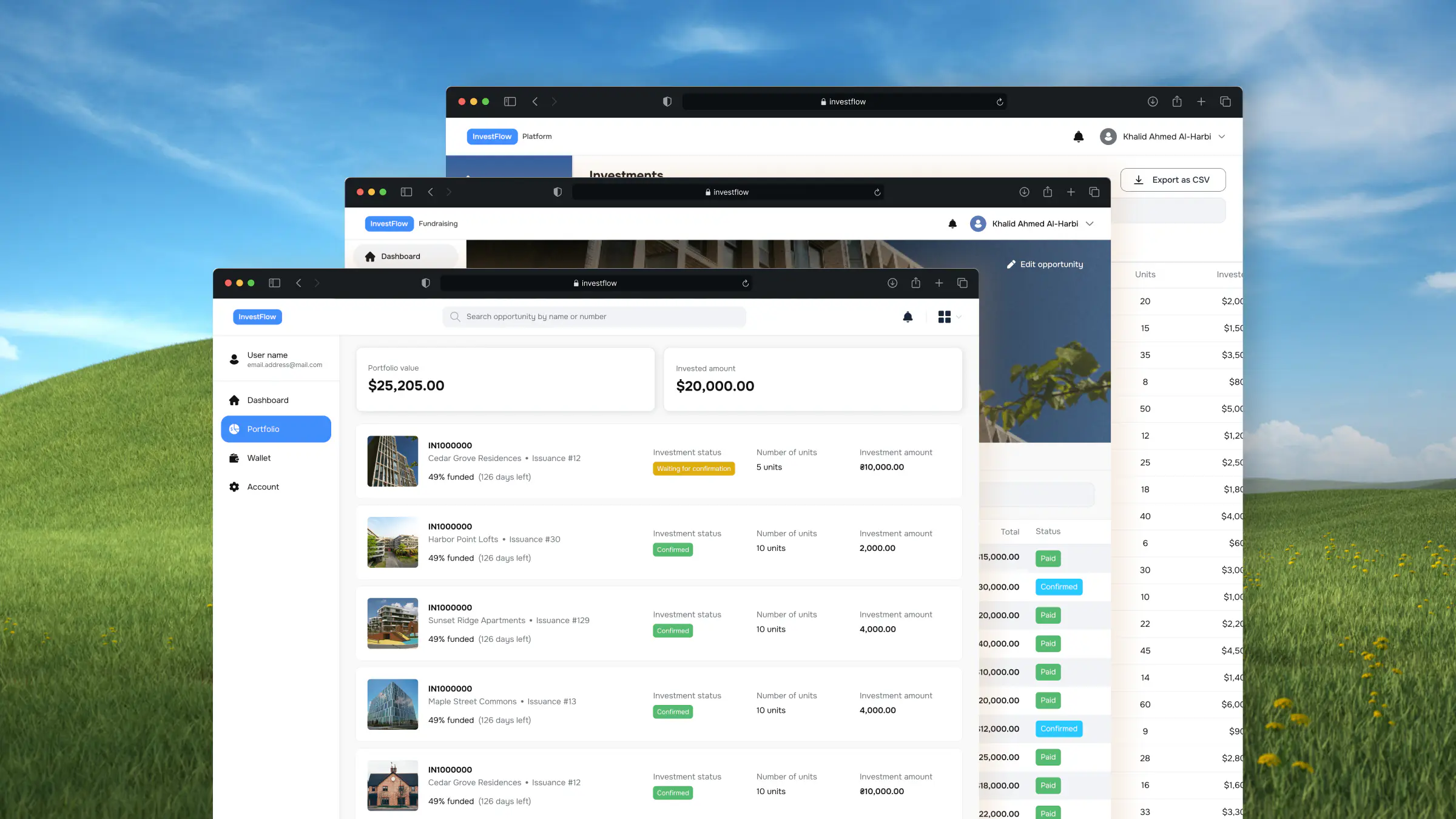
Building a multi-product MVP — spanning the investor web and mobile app, the fundraiser portal, and the internal back-office powering operations behind the scenes.
- Role
- UI/UX designer
- Timeline
- 2024–2025
- Platform
- Web, iOS, Android
- Scope
- Investor App · Fundraiser Portal · Back-Office
Context
InvestFlow is a crowdfunding platform connecting investors with real estate and alternative asset opportunities, while enabling fundraisers to raise capital for their projects. Built from the ground up as an MVP, the product brings together three interconnected experiences — an investor app, a fundraiser portal, and an internal back-office — all powered by a single underlying platform.
As the sole UX/UI Designer, I led the design across all three products end-to-end — translating product requirements into information architecture, user flows, and final interfaces across web and mobile.
Design all three products from scratch — translating complex business requirements and operational workflows into clear user flows and a cohesive ecosystem.
Approach
How the problem was solved
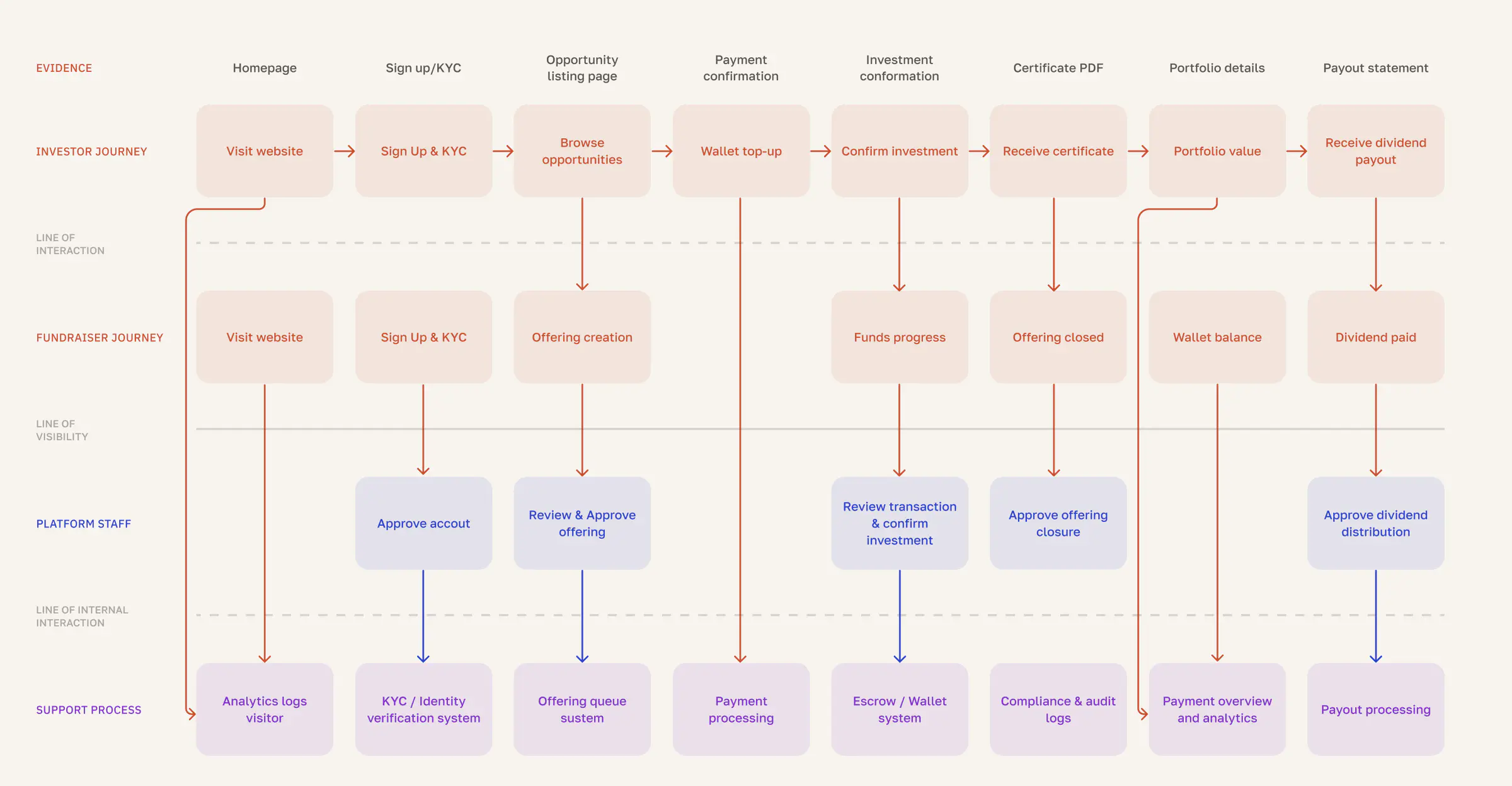
Before designing individual screens, I mapped out the core journeys for each user role and how they intersect. A single investment opportunity travels across several parts of the system: a fundraiser creates and submits it, the operations team reviews and manages it in the back-office, and investors discover and fund it.
Building a Service Blueprint connected front-stage user flows with the operational processes happening behind the scenes, giving me a solid framework to design all three products consistently.
01 / 03
Investor
The web and mobile investor experience covers the entire investment lifecycle — from initial onboarding and financial qualification to discovering deals, committing capital, and tracking portfolio performance.
Investor
Onboarding & KYC
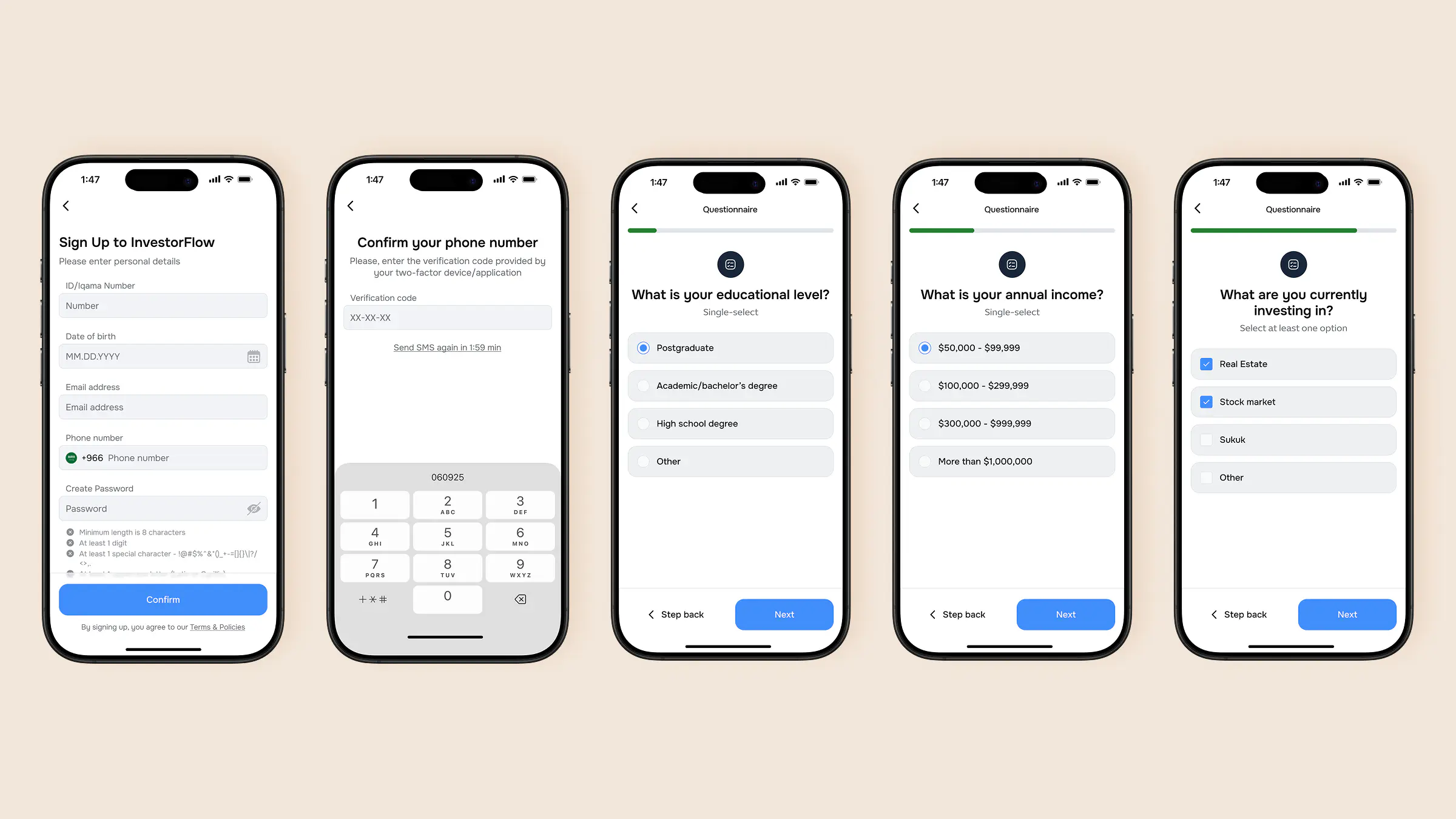
In regulated fintech products, sign-up requires KYC verification and suitability checks. To prevent drop-off during this mandatory step, I broke the flow down into digestible steps — guiding users smoothly through personal details, phone verification, and a quick questionnaire on annual income and investment experience and current asset classes (Real Estate, Stock market, Sukuk).
Investor
Deal Evaluation & Details
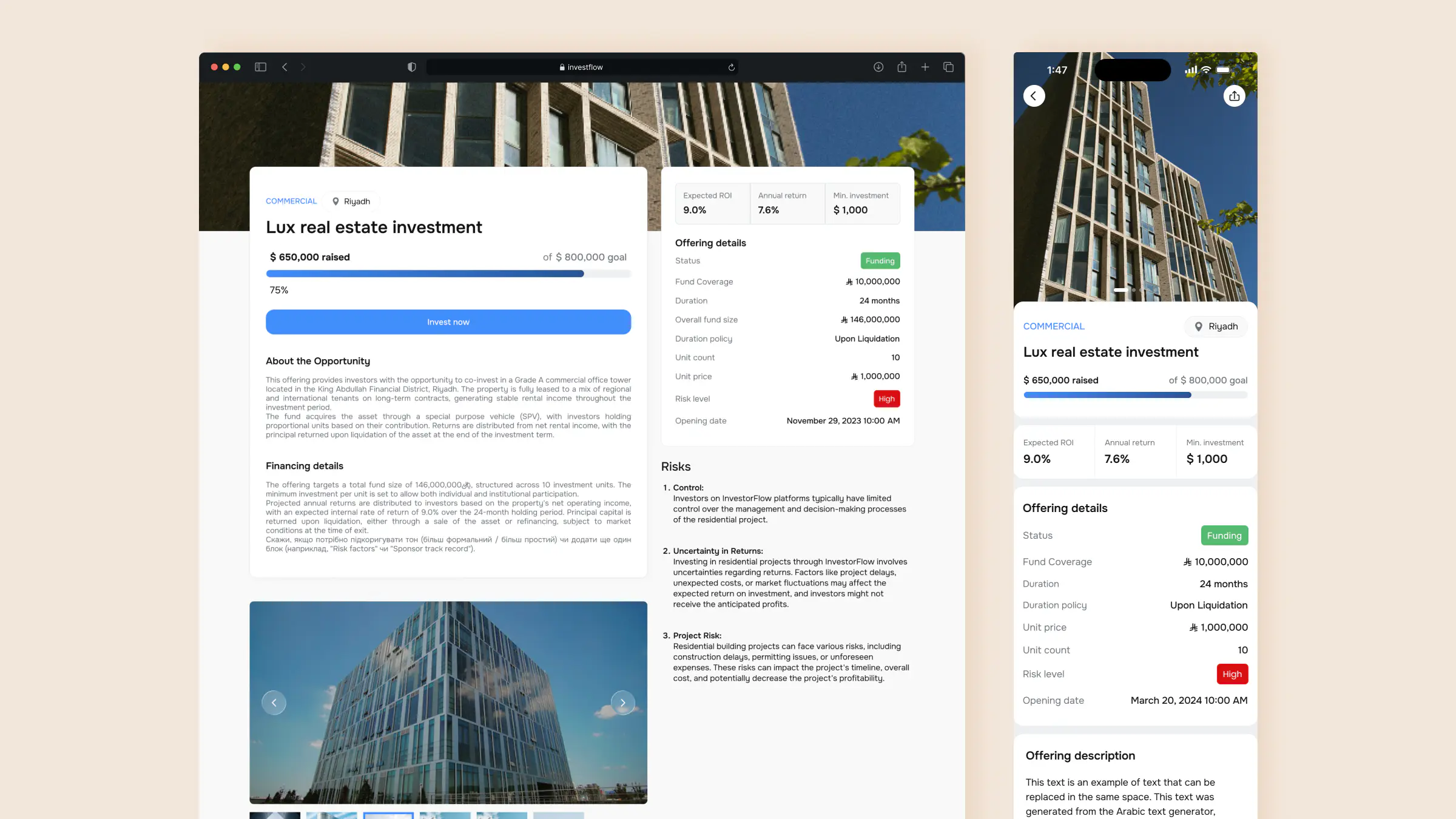
When exploring properties, investors need to quickly assess projected returns, risks, and funding progress. I structured the catalog and project page to highlight core financial metrics and terms upfront, enabling a seamless transition to investing with a single click.
Investor
Investment Flow & Portfolio
The checkout experience is designed for clarity and confidence: investors select the desired number of investment units, see the calculated total upfront, сonfirm and complete the transaction. Once invested, the asset appears in the user's portfolio, which provides a clean, structured overview of all current holdings and their status.
02 / 03
Fundraiser
A web portal for companies raising capital — built to create investment offerings, submit them for review, and track fundraising progress and payouts.
Fundraiser
Tracking Campaigns & Investments
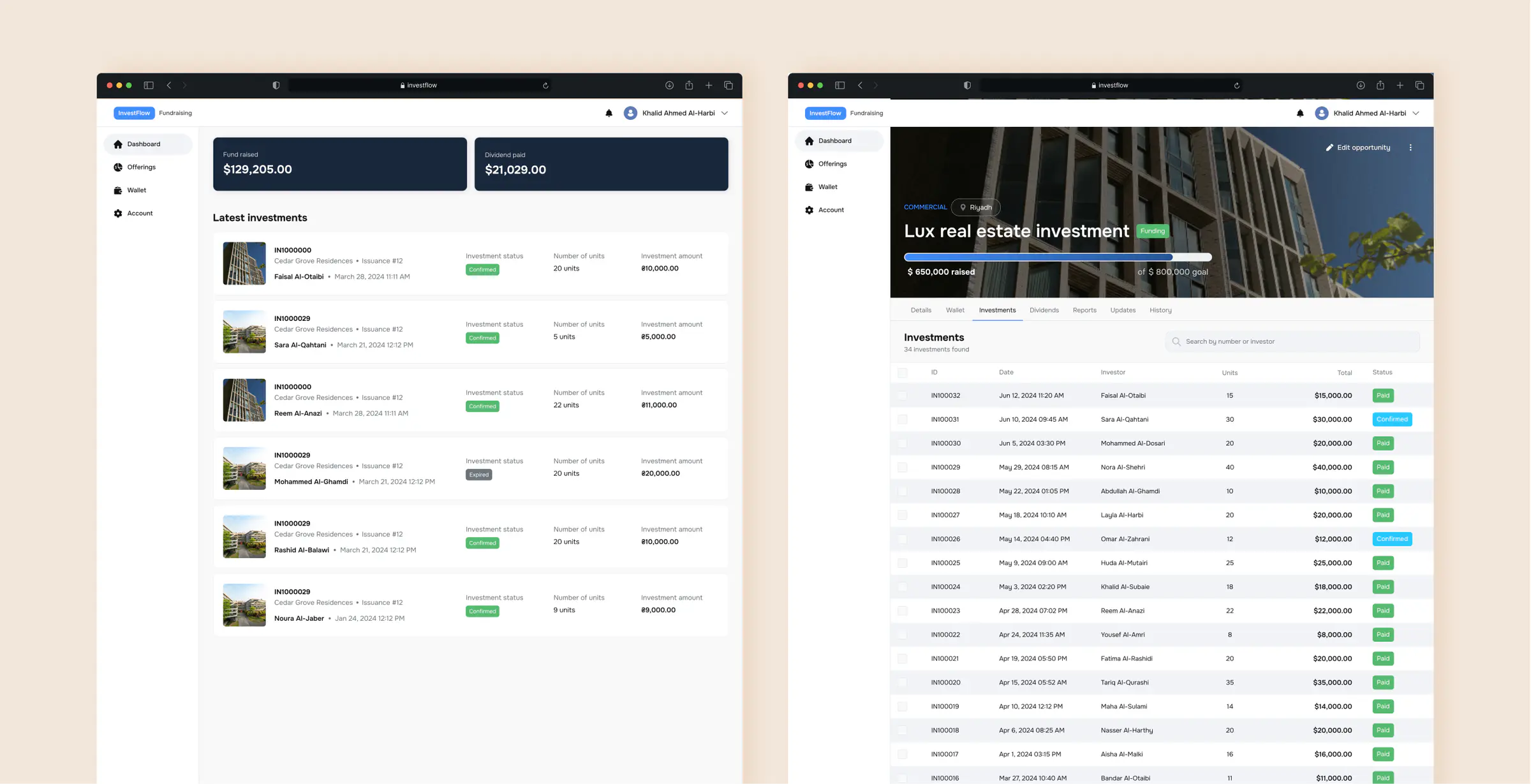
The main dashboard gives an instant overview of total funds raised, dividends paid, and recent investor activity. Drilling down into a specific property reveals overall funding progress alongside a searchable table of all investors, their payment statuses, unit counts, and transaction amounts.
Fundraiser
Step-by-step offering setup
Because launching a deal involves a lot of financial data, I broke the flow into a clean few-step wizard instead of a single long form. Fundraisers move step by step through general terms and expected ROI, property details and location, media uploads, and unit pricing — with the total fund coverage calculated automatically before submission.
03 / 03
Back-office
An internal platform for the operations team to run the marketplace behind the scenes — handling deal reviews, investment confirmations, user management, and dividend approvals.
Back-office
Managing investments and transactions
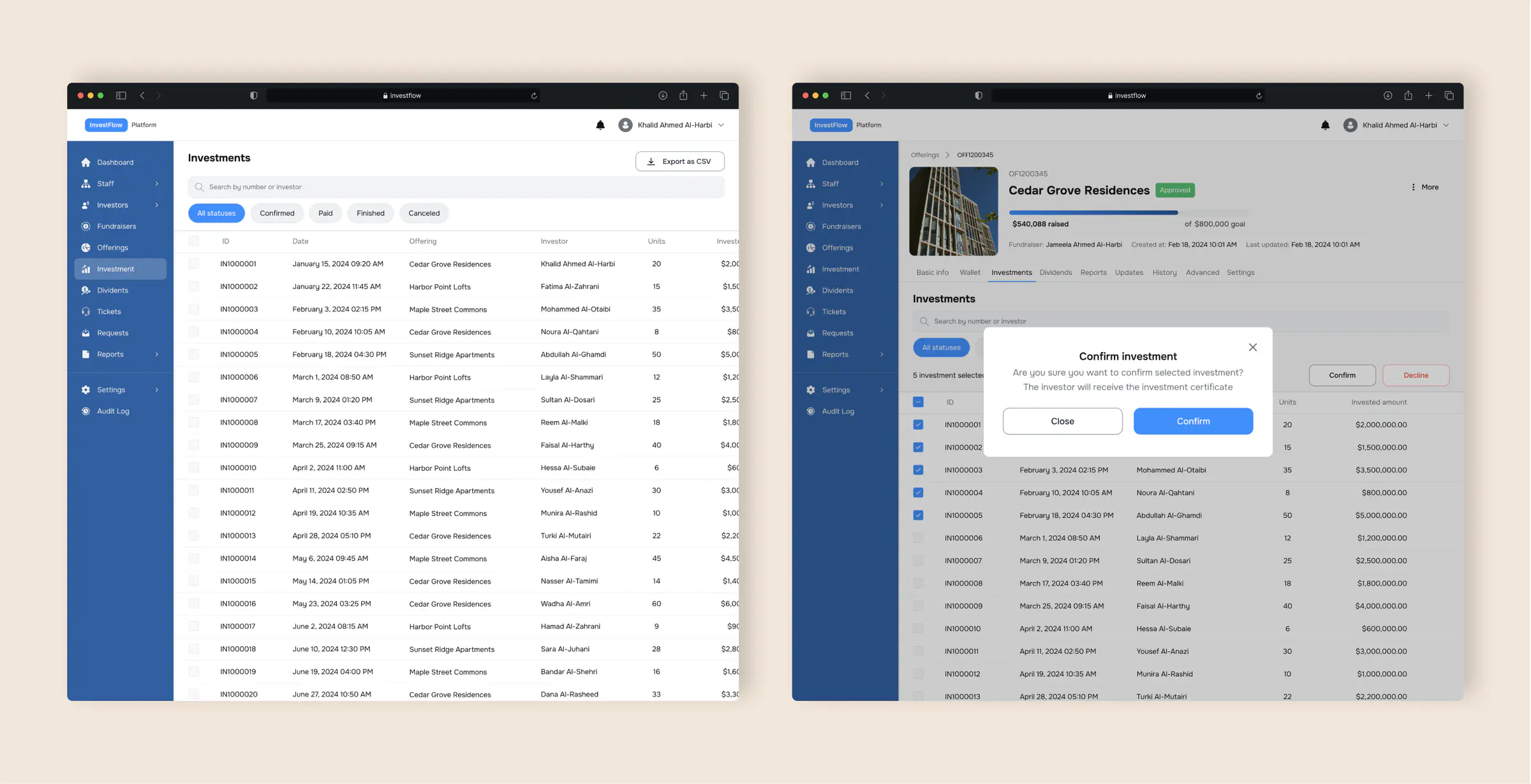
Since every transaction requires internal verification, the back-office focuses on scannable tables, search, and quick status filters. Staff can view investments globally (with one-click CSV export) or within a specific offering — selecting multiple entries at once to confirm investments in bulk and trigger investor certificates.
Back-office
Approving dividend payouts
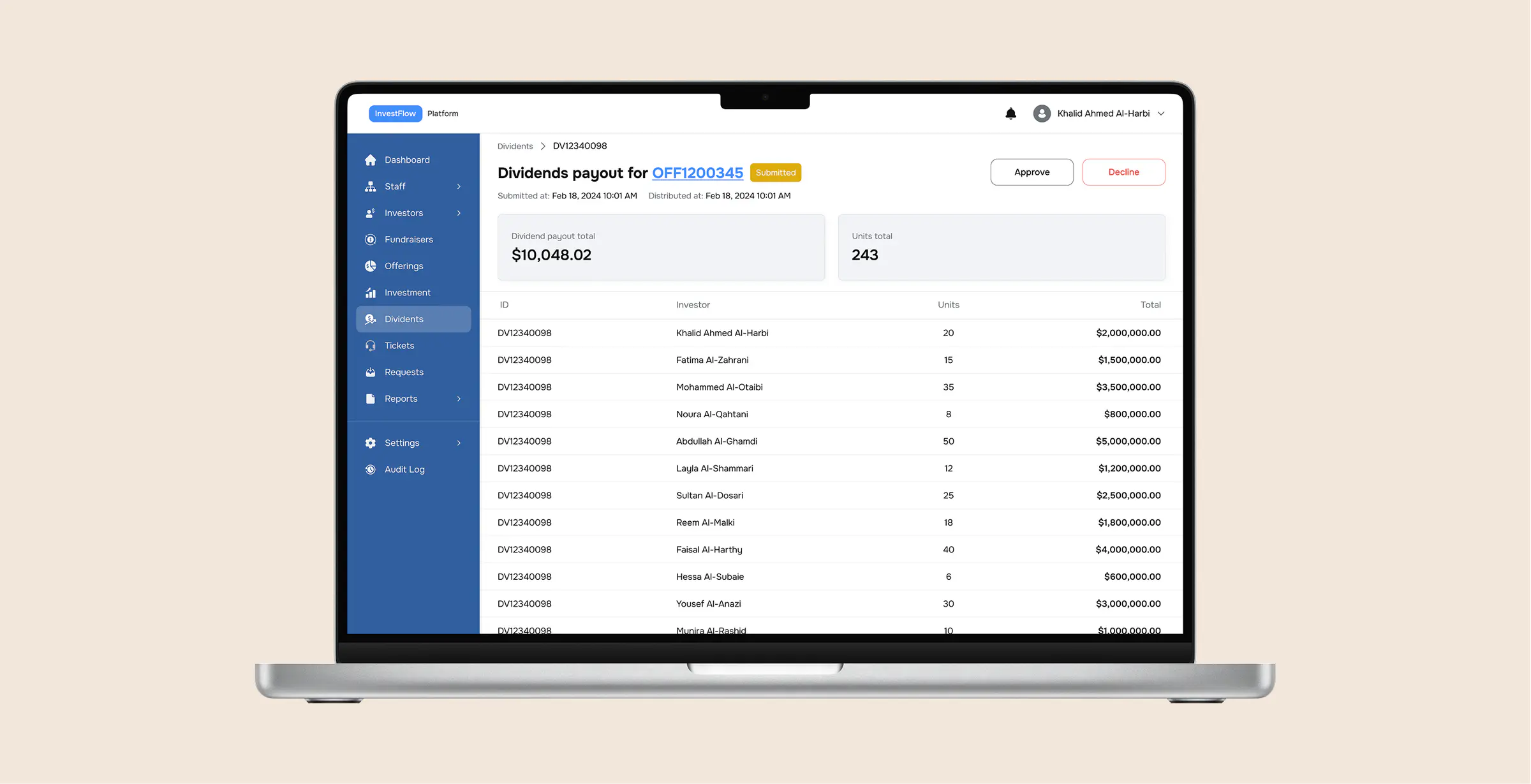
A dedicated module handles profit distributions to investors. Each payout request displays the total dividend amount, unit count, and a per-investor breakdown — allowing managers to review the numbers and approve or decline the payout in a single click.
Conclusion
Designing InvestFlow reinforced how critical it is in multi-sided products to design the connections between roles, not just isolated screens. When investors, fundraisers, and operations staff share one ecosystem, every action in one interface triggers a workflow in another.
Mapping the end-to-end logic through a Service Blueprint and a shared design system made it possible to build three distinct products from scratch as one cohesive MVP — pairing a simple, transparent experience for external users with a clear operational backbone behind the scenes.
Other work
0301RozetkaPayFintech / B2CUncovering why buyers abandon RozetkaPay express-checkout, and turning 12 interviews, a usability audit, and a competitor analysis into a clearer path to purchase.02DramoxEntertainment / UXTurning research into a clearer discovery experience — and a feedback loop for continuous learning.04SnobarAutomotive / Social networkA dedicated space for car lovers — bringing together social feeds, short videos, Q&A discussions, and vehicle profiles into one unified system.